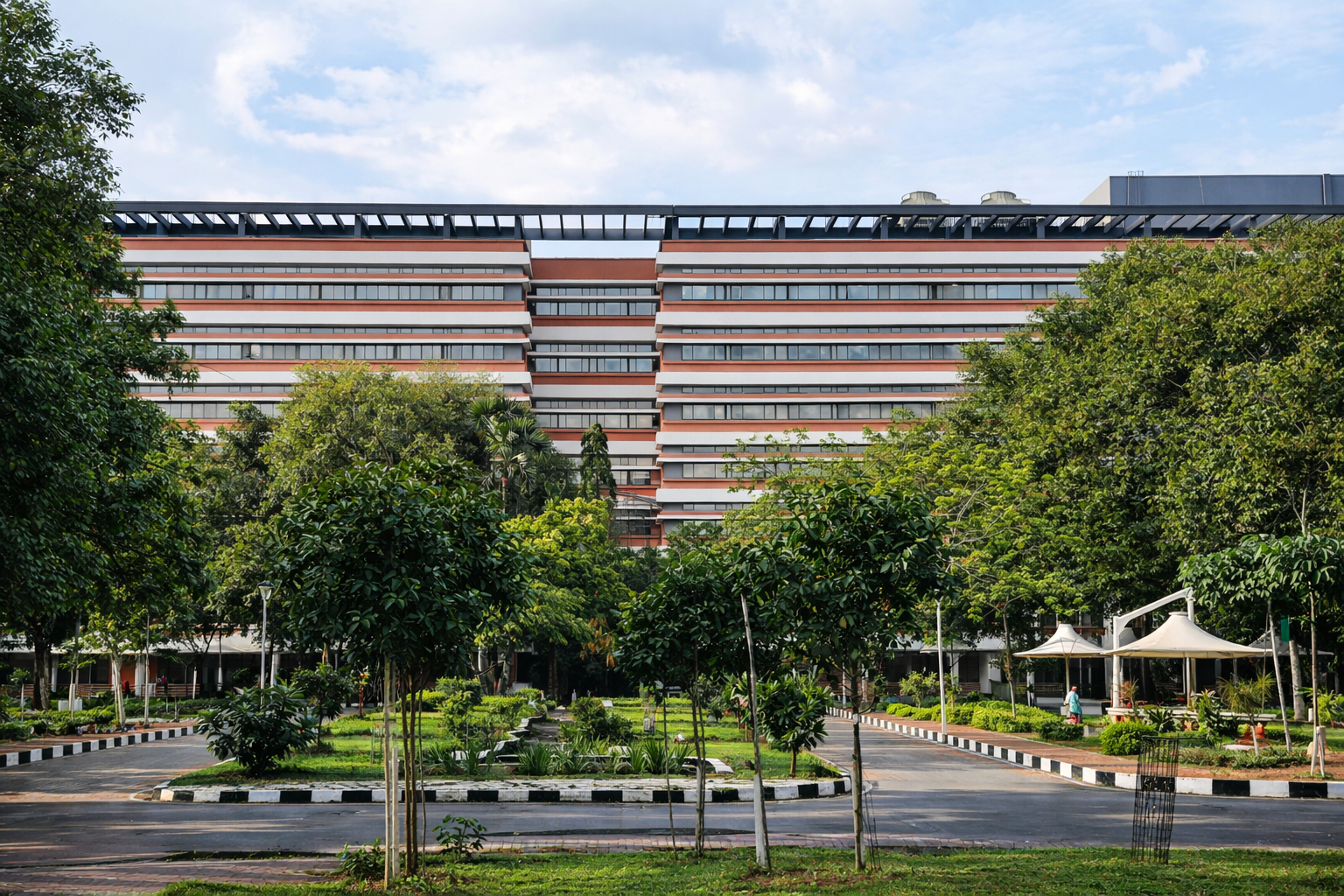
Our Journey
From a bold vision in 2018 to a world-class brain research facility, tracing the milestones of the Sudha Gopalakrishnan Brain Centre.
Mapping the human brain is crucial for understanding how the brain works, including the processes by which we think, feel, learn, and remember. Historically, brain mapping began in the late 19th and early 20th centuries. In the mid-20th century, advances in microscopy and histology led to the development of cytoarchitectonic maps. While the late 20th century brought imaging breakthroughs such as MRI and PET, the 21st century ushered in large-scale initiatives aimed at generating detailed maps of brain structure, function, and gene expression.
The global pursuit to understand the human brain has led to the launch of several landmark initiatives over the past two decades, each building on the progress of the last. Together, they reflect a chronological evolution in neuroscience, moving from foundational mapping and modelling efforts to more integrative, technology-driven approaches.
India's Growing Role in Neuroscience
Brain research in India, though once dormant, is now a rapidly growing field driven by pioneering institutions working relentlessly. India's expanding network of neuroscience research institutions reflects a strong and evolving commitment to brain research. Together, they aim to bridge the gap between scientific discovery and improvements in public health.
The Birth of SGBC
In 2018, at the Indian Institute of Technology Madras (IITM), a bold vision emerged: to slice and image over 100 whole human brains across different age groups and disease conditions, each section only 10-20 microns thick and covering billions of neurons across the whole brain. With no existing frameworks, dedicated labs, or infrastructure, the team had to build the path from scratch. From fundraising and laying the foundation to assembling cutting-edge facilities and bringing together a diverse group of passionate researchers, every step advanced the realisation of this idea.
Today, that vision stands realized in the form of the Sudha Gopalakrishnan Brain Centre (SGBC), a rare milestone in research and a symbol of India's multidisciplinary commitment to understanding the intricate workings of the human brain.
The centre has developed world-class brain imaging technology that converts whole human brains into high-resolution digital 3D images. These unique 3D images of human brains across different ages offer an unprecedented view, revealing cellular-level details throughout the entire brain.
This data is being shared with and studied by globally leading brain researchers for neuroscience discovery, leading to medical applications. This first-of-its-kind research platform and data sets have attracted more than 20 globally leading brain researchers from institutions in the US, Germany, Croatia, Romania, South Africa, and Australia to work closely with the IITM Brain Centre and have become visiting faculty at IITM, this collaboration continues to expand.
The Centre is supported by the Office of Principal Scientific Adviser (PSA), Kris and Sudha Gopalakrishnan, Azim Premji's Premji Invest, Prem Watsa (Fairfax), Prema Srinivasan Charities, Hindalco, Fortis Hospitals, Agilus Diagnostics, Bill and Melinda Gates Foundation, Dr. Reddy's Labs, Hemendra Kothari Foundation, AMM Foundation (Murugappa Group), Krishnan Care Beyond Bound Trust, Ford Motor. NVIDIA, the leading AI company, has partnered with the Centre to process and analyse the petabytes of brain data.
Birth of DHARANI
Recently, SGBC released "DHARANI", a three-dimensional meta-atlas of the second-trimester human fetal brain. The name, an acronym for Developing Human-brain Atlas Resource to Advance Neuroscience Internationally, also pays tribute to the Hindu goddess of the Earth and of beginnings, symbolising the unfolding complexity of the developing brain.
In December 2024, this far-sighted vision was realised at a larger scale when the team at IIT Madras published the first dataset from this ambitious project in the Journal of Comparative Neurology. Representing the first 3D atlas of the second-trimester developing human brain across five gestational ages, it marks a landmark achievement in neuroscience. For the first time, India generated such high-quality human brain data and made it publicly available as a global resource. This accomplishment has garnered significant international attention, including a detailed editorial in the world's oldest neuroscience journal titled "India Gets a Seat at the Table of Human Brain Cartography"
Towards a Global Milestone
The Centre is on its way to make India the first country globally to generate 100+ 3D human brain maps and generate the largest repository of human brain data in the world that will serve as a global reference for decades to come.
While the world came to a standstill during the COVID-19 pandemic between 2020 and 2022, work at the centre continued relentlessly. The effort resulted in 5,132 plates of developing human brains spanning gestational weeks 14, 17, 21, 22, and 24, with 466 of these fully annotated to capture nearly 500 brain structures as they take shape.
This is a rare example of cutting-edge research in India generating technology, data and global visibility at 1/10th of the global costs by leveraging domestic talent, ecosystem and international collaborations.