Genetic, Cellular and Intercellular Principles of Human Brain Development
A lecture by Dr. Tomasz Nowakowski, Associate Professor at UC San Francisco
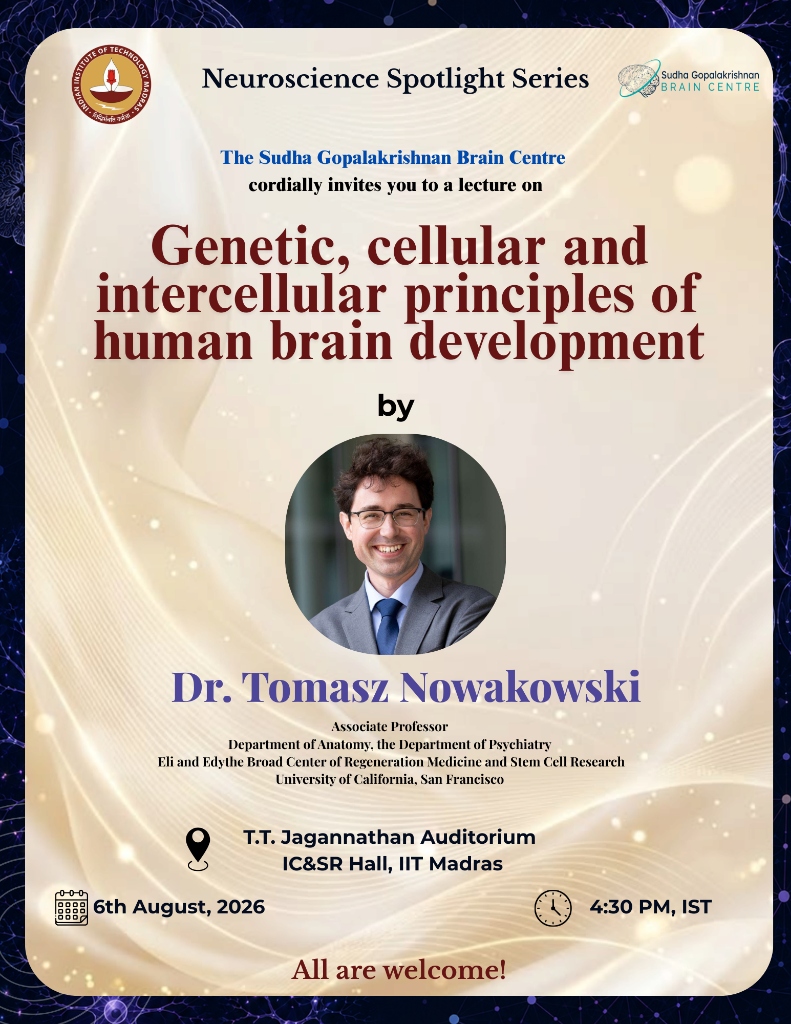
The human brain is built from a single sheet of stem cells that, over months, generates hundreds of distinct cell types and wires them into functioning circuits. This process follows two design rules. The first is a schedule: individual stem cells produce different cell types in a fixed temporal order, like a manufacturing line that changes its output over time. The second is a map: a cell's physical location determines whether it becomes an excitatory neuron (which activates its targets) or an inhibitory one (which suppresses them). We study how these rules were rewired during human evolution to build a larger, more complex cortex while preserving the critical balance between excitation and inhibition.
A central challenge is that most methods capture only static snapshots of cells, not the dynamic history of how each one arose or what it connects to. To recover that history, we engineer viruses that tag each stem cell with a unique molecular "barcode," so that all of its descendants can be identified by sequencing—effectively a lineage tracking system for cells. Using these tools on human tissue, we find that some inhibitory neurons are produced locally alongside excitatory neurons from a shared origin, and that certain stem cells keep generating neurons far later than expected. A second barcoding system, built on rabies virus, lets us reconstruct which neurons connect to which, revealing transient wiring patterns unique to development. Finally, we overlay these developmental maps onto genetic data from autism, pointing to disrupted circuit formation in a specific brain region as a possible convergent mechanism. Together, these approaches turn static catalogs of cell diversity into a working understanding of the programs that assemble the human brain.
Dr. Tomasz Nowakowski
Associate Professor, UC San Francisco
Dr. Nowakowski's single-cell RNA sequencing work on the developing human brain led to his Supragranular Cortex Expansion Hypothesis. Since founding his lab in 2017, his research has combined single-cell genomics, genome engineering, and tissue modeling to understand how the human genome builds the neuronal cell types that support cognition and how this process goes awry in autism and schizophrenia.